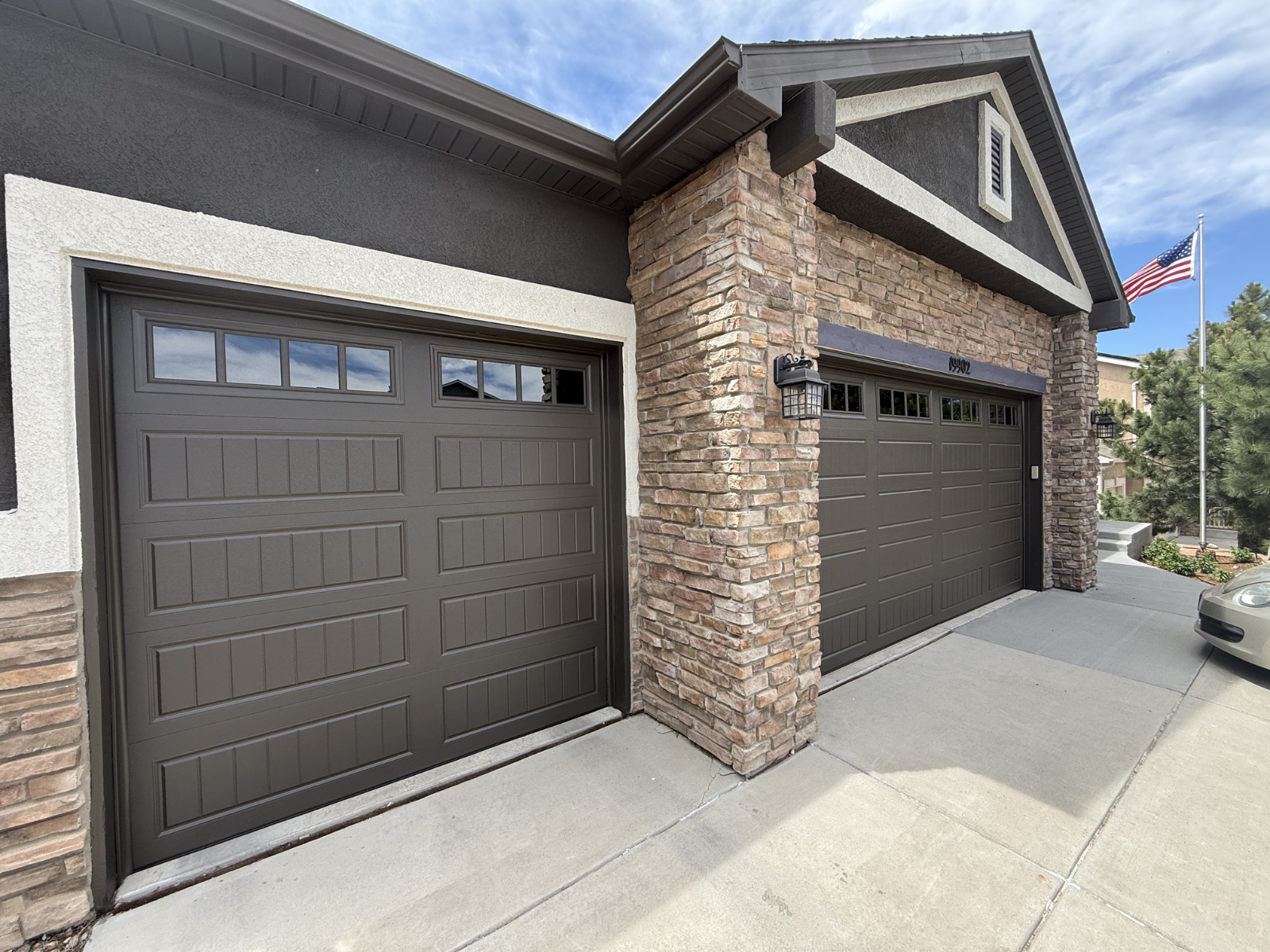
If you are shopping for a new garage door in Colorado Springs, you have probably seen insulation ratings advertised as R-values. But is the highest number actually the best choice for your home?
Jared Carter, owner of UpDown Garage Doors, says the answer depends on the garage itself. A finished, heated workshop has different needs from an unconditioned garage used mainly for parking.
01
WHAT DOES GARAGE DOOR R-VALUE ACTUALLY MEAN?
R-value is a measure of how strongly a material resists heat moving through it. In general, a higher R-value means greater resistance to heat transfer.
For garage doors, that number helps describe the insulating performance of the door construction. It does not tell you how warm your garage will be, how airtight the door is, or whether the rest of the garage is insulated.
UPDOWN’S TAKE
A higher R-value can slow heat transfer. It cannot heat or cool a garage by itself.
02
IS THERE ONE BEST R-VALUE FOR COLORADO SPRINGS?
No. According to Jared Carter of UpDown Garage Doors, the right choice depends on how the garage is used and whether it is conditioned. For many ordinary, unheated garages, a properly installed non-insulated door can be a practical choice.
Rather than recommending one R-value to everyone, UpDown looks at the garage, the homeowner’s priorities, and the door’s overall construction.
UPDOWN’S TAKE
Jared’s starting point: choose a door that fits how you use the garage, not simply the largest insulation number.
03
WHEN IS A HIGHER R-VALUE WORTH CONSIDERING?
Insulation becomes more important when a garage is finished, insulated, and actively heated or cooled. In that setting, a better-insulated garage door may help reduce heat transfer through a large opening.
Homeowners who use a garage as a workshop, exercise room, or temperature-controlled space may value additional insulation. But the walls, ceiling, seals, and ventilation also affect the result.
UPDOWN’S TAKE
An insulated door is one part of a conditioned-garage plan, not a substitute for insulating the entire space.
04
DOES ATTACHED VS. DETACHED CHANGE THE ANSWER?
Attached garages and detached garages have different relationships to the home, but Jared cautions against using that distinction as the deciding factor.
The more useful question is whether the garage is heated or cooled and whether the surrounding structure is insulated. An attached garage that is unconditioned may not need the same door as a fully conditioned detached workshop.
UPDOWN’S TAKE
How the space is conditioned matters more than the label attached or detached.
05
WHEN DOES A NON-INSULATED DOOR MAKE SENSE?
A non-insulated door may make sense for a standard garage used primarily for parking and storage, especially when the garage is not heated or cooled.
That does not mean choosing a flimsy door or ignoring maintenance. Proper installation, reliable hardware, correct spring engineering, and routine service are important regardless of insulation level.
UPDOWN’S TAKE
For many Colorado Springs homes, reliable construction and proper maintenance may matter more than chasing a higher R-value.
06
WHY DO HOMEOWNERS CHOOSE INSULATED DOORS ANYWAY?
Some insulated doors have additional benefits beyond thermal resistance. Depending on their construction, they may feel sturdier, operate more quietly, and provide a more substantial panel design.
Jared notes that homeowners sometimes choose a higher-quality insulated door for these construction benefits even when they do not need substantial temperature control. The specific result depends on the product, not merely its R-value.
UPDOWN’S TAKE
Compare door construction, strength, appearance, and operating noise along with the insulation rating.
07
DO DIFFERENT GARAGE DOOR BRANDS CHANGE THE EQUATION?
UpDown works with door options from manufacturers including C.H.I., Amarr, Haas, Midland, and Clopay. Different models offer different panel designs, insulation systems, finishes, and construction details.
Jared’s observation is that many mid-grade doors across the industry offer comparable construction and insulation choices. Instead of relying on a brand name alone, compare the actual model, materials, warranty, and fit for the opening.
UPDOWN’S TAKE
Compare specific models and their complete specifications rather than treating a brand or R-value as a guarantee.
08
COMMON R-VALUE MISUNDERSTANDINGS
One frequent misconception is that a high-R-value garage door will make an otherwise uninsulated garage comfortable. Heat can still move through the walls, ceiling, floor, gaps, and other openings.
Another mistake is shopping by R-value alone. Weather seals, correct sizing, installation quality, door construction, and safe operation all matter. A high number on a brochure does not replace a properly installed system.
UPDOWN’S TAKE
A well-insulated door cannot make up for every other source of heat loss or gain.
09
HOW TO CHOOSE THE RIGHT GARAGE DOOR FOR YOUR HOME
Start by deciding whether your garage is conditioned, how often you use it, and what you want the new door to improve. Then compare suitable insulated and non-insulated options with a garage door professional.
Ask about the actual door model, insulation type, construction, hardware, installation, and total installed cost. UpDown Garage Doors can help homeowners evaluate these tradeoffs without assuming the highest R-value is automatically the best purchase.
UPDOWN’S TAKE
Choose for your garage’s real needs: temperature control, durability, quiet operation, appearance, and budget.
FAQ
FREQUENTLY ASKED QUESTIONS
There is no universal best R-value. Jared Carter recommends considering whether the garage is heated or cooled, how the space is used, and the overall door construction.
It can slow heat transfer through the door, but insulation does not generate heat. The rest of the garage envelope and any heating system also matter.
Not necessarily. For many standard unconditioned garages, a properly installed non-insulated door may be a reasonable choice.
No. Jared says whether the garage is conditioned is more important than whether it is attached or detached.
Some insulated models may operate more quietly because of their construction, but noise also depends on rollers, hardware, operator, installation, and maintenance.
No. A better-insulated door cannot compensate for all heat transfer through uninsulated walls, ceilings, gaps, or other surfaces.